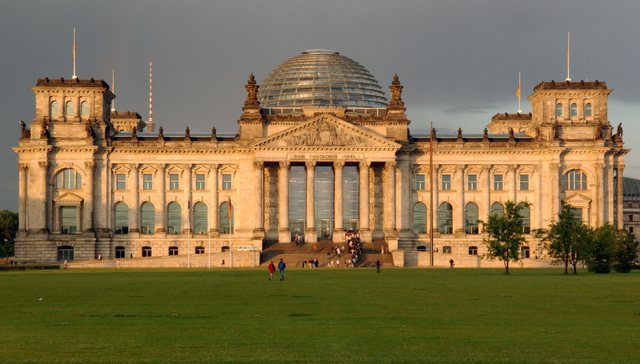
Germany has a federalist system of government, in which the German Lander have considerable autonomous power, akin to the power that American states have. Each individual Land has individual control over things such as its police, medical care, education, and so on. THE EXECUTIVE BRANCH The German government has both a federal president, called the Bundesprasident, and a chancellor. The chancellor is Germany's equivalent of a prime minister, and has considerable power, as opposed to the weak Bundesprasident. Germany's president serves as a "head of state", not as a "chief of government" - the chancellor assumes this role. The president's powers include dissolving the Bundestag (Germany's lower house of Parliament) upon the chancellor's request, proclaiming laws after they have been passed by parliament, and appointing and/or dismissing the chancellor, after receiving instruction to do so from the leading party. Germany's chancellor is able to pick his or her own cabinet and defending his or her party's policies. THE LEGISLATIVE BRANCH In Germany, as in Britain, the cabinet can be voted out. However, in Germany, a new cabinet must be voted in when an old cabinet is voted out. This process is called constructive no-confidence. However, this has happened only once (in 1982). Regarding Germany's cabinet, it is considerably smaller than the U.S. President's cabinet, and most of its members are also working politicians - similar to the British system. Germany's parliament is called the Bundestag. Currently, it has 614 members, but it typically has a minimum of 598 members. The lower house of Germany's parliament is called the Bundestag, and the upper house is called the Bundesrat. THE JUDICIAL BRANCH Additionally, Germany has a constitutional court, called the Federal Constitutional Court, which functions in a manner similar to the U.S. Supreme Court. Its decisions are highly important. THE ELECTORAL PROCESS Germany has a mixed-member (MM) political system, which means it combines proportional representation with single-member districts. In practice, the German system works as proportional representation. The percentage of seats a party receives in Bundestag is nearly equal to the amount of votes that the party receives. The only difference is that, in Germany's system, there is the additional factor of single-member districts. However, Germany established a threshold clause to prevent extremist parties from gaining seats in Bundestag. This clause establishes the minimum percentage of votes that the party must win to obtain any seats in the Bundestag. Currently, the minimum percentage has been established at 5% to obtain any Bundestag seats from proportional representation; however, the party has any single-member-district seats that it won regardless of whether or not it meets the 5% threshold. | Germany's current government leaders are the following: President - Horst Koehler Chancellor - Angela Merkel Vice Chancellor - Guido Westerwelle Minister for Consumer Protection and Agriculture - Ilse Aigner Minister of Defense - Karl-Theodor Zu Guttenberg Minister for Economic Cooperation and Development - Dirk Niebel Minister for Economics and Technology - Rainer Bruederle Minister for Education and Research - Annette Schavan Minister for Environment and Nuclear Safety - Norbert Roettgen Minister for Family, Seniors, Women, and Youth - Kristina Schroeder Minister of Finance - Wolfgang Schaeuble Minister of Foreign Affairs - Guido Westerwelle Minister for Health - Philipp Roesler Minister of Interior - Thomas De Maiziere Minister of Justice - Sabine Leutheusser-Schnarrenberger Minister for Labor and Social Security - Ursula von der Leyen Minister for Transportation, Construction, and Urban Development - Peter Ramsauer Minister without Portfolio and Chancellery Chief - Ronald Pofalla President, Bundesbank - Axel A. Weber Ambassador to the United States - Klaus Scharioth Permanent Representative to the UN, New York - Peter Wittig |
